
On the farthest edge of a small, wind-brushed island stood a lighthouse with whitewashed stones and a red roof that shone like a berry in summer. The sea wrapped around the island in every shade of blue—deep sapphire in the distance, pale and glassy near the shore where tiny crabs traced delicate patterns in the sand.
Inside that lighthouse lived a girl named Mira and her grandfather, who had once been the strongest sailor along the coast. Time had softened his steps and silvered his hair, but his voice still carried the steady warmth of someone who trusted the sea and understood its moods.
Mira loved the lighthouse more than any other place in the world. She loved the spiral staircase that creaked politely beneath her feet, the round windows that framed the horizon like living paintings, and the great lantern room at the top, where the glass panes caught the sunlight and scattered it into shy rainbows along the walls.
Each evening, just before dusk, her grandfather would light the great lamp. Its beam would turn slowly, casting a bright path over the water so ships could find their way safely through the rocky channels.
“It’s not the brightness alone that guides them,” he once told her, polishing the brass railing with a careful hand. “It’s the steadiness. A light that does not give up.”
Mira carried those words quietly in her heart.
One autumn, when the wind began to taste of salt and faraway storms, her grandfather caught a fever that made his cheeks burn and his steps uncertain. For the first time since Mira could remember, he did not climb the stairs at dusk.
The responsibility of the lighthouse felt suddenly larger than the sea itself.
Mira stood at the foot of the spiral staircase, listening to the wind hum in the chimney. The sky outside was already turning lavender. Fishing boats were returning to harbor, their sails folding like tired wings.
She swallowed and placed her small foot on the first step.
The staircase seemed steeper than usual. The iron railing felt colder beneath her palm. Halfway up, she paused, her breath fluttering like a trapped moth. The lantern room at the top looked impossibly high.
But below her, in the small bedroom with its patchwork quilt, her grandfather rested. And beyond the island, ships would soon be sailing through darkening waters.
Mira lifted her chin and continued climbing.
The lantern room smelled faintly of oil and warm metal. She had watched her grandfather light the lamp a hundred times, but doing it herself made her hands tremble. The wick needed trimming. The glass panes required wiping free of salt spray. The mechanism that turned the light had to be wound carefully, not too tight, not too loose.
She moved slowly, repeating each step as she had seen him do.
Trim the wick.
Polish the glass.
Fill the reservoir.
Strike the match.
When the flame caught, it flickered uncertainly, as though deciding whether to stay. Mira shielded it with her hand, whispering softly—not words of fear, but of encouragement.
The flame steadied.
Soon the great beam of light began its patient rotation, sweeping across the darkening sea. It was not as bright as usual, perhaps. Or perhaps that was only Mira’s worry speaking. Still, it shone. It turned. It reached out into the night.
Far below, waves rolled in and out against the rocks in their timeless rhythm.
From that evening on, Mira became the lighthouse keeper.
Each day carried new challenges. The oil barrels were heavier than she expected. The stairs seemed longer when climbed twice, three times, sometimes four if the mechanism stuck. There were moments when her arms ached and her legs felt as though they belonged to someone much smaller and less brave.
One particularly blustery night, a storm gathered with surprising speed. Clouds swallowed the moon. Rain lashed against the glass panes, and the wind pressed against the lighthouse as if trying to push it from its foundation.
Mira woke to the sound of the mechanism grinding.
She knew that sound.
The light had stopped turning.
For a heartbeat, she lay very still in the dark, listening to the wind roar like an angry ocean creature. The bed felt warm. The blankets felt safe. The storm sounded enormous.
Then she remembered the boats.
She imagined them beyond the curtain of rain—small, determined specks in a restless sea, looking for the steady sweep of light.
Mira slipped from her bed and wrapped herself in her grandfather’s old wool coat. It hung nearly to her ankles and smelled faintly of cedar and salt.
The climb that night felt endless. The staircase groaned with each gust of wind. Rain found its way through the smallest cracks and tapped against the stone like impatient fingers.
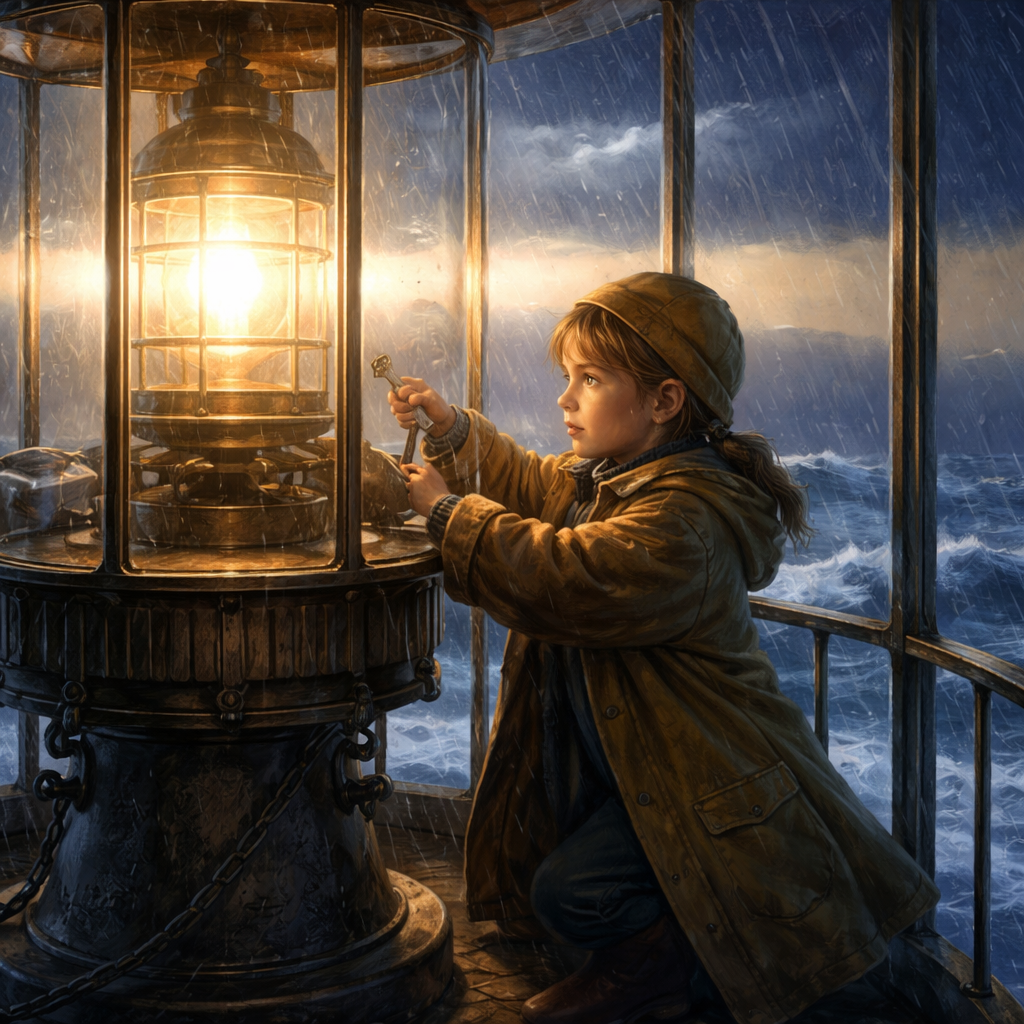
In the lantern room, the flame still burned, but the turning mechanism had jammed. The beam shone in a single direction, frozen and incomplete.
Mira’s heart thudded.
She wiped rain from her face and knelt beside the gears. Her grandfather had shown her how the cogs fit together, how each tooth depended on the next. She could almost hear his voice explaining it in his calm, steady way.
“Everything works together. If one piece falters, another must help.”
She took a deep breath and began to examine the gears. One small bolt had loosened, likely shaken by the wind. The metal teeth no longer aligned.
Her fingers were stiff from cold, and the wind howled so loudly it seemed to rattle her thoughts. She tried once to tighten the bolt, but her grip slipped. She tried again, pressing her lips together in concentration.
The bolt turned slightly.
Again.
And again.
Slowly, the teeth found their place. The mechanism gave a reluctant shudder and then, with a soft grinding sigh, began to move.
The beam resumed its faithful sweep across the sea.
Mira sat back on her heels, breathing hard, rainwater dripping from her hair. The storm still raged, but the light turned steadily, bravely, as though it had never paused at all.
In the days that followed, her grandfather began to recover. His fever broke, and strength returned to his voice, though not yet to his legs. He listened carefully as Mira described the storm and the stubborn bolt.
He did not interrupt. He did not correct.
When she finished, he smiled in a way that made the corners of his eyes crinkle like folded maps.
“The sea respects those who do not yield to it,” he said quietly. “And so do I.”
Winter settled over the island in soft gray layers. The sea grew quieter, its surface sometimes smooth as brushed silk. Mira continued her duties, even after her grandfather was strong enough to climb the stairs again. He let her take the lead, offering guidance only when asked.
She no longer hesitated at the foot of the staircase. The steps had become familiar companions, each creak a greeting rather than a warning. Her hands grew sure with the wick and the oil, confident with the winding key.
One evening, as the sun melted into the horizon like warm honey, a distant ship sounded its horn in a long, low note of gratitude. Mira stood in the lantern room, watching its lights blink in reply to the lighthouse beam.
She felt something settle inside her then—a quiet understanding that determination was not loud or dramatic. It did not stamp its feet or shout at the storm.
It climbed the stairs even when they felt steep.
It tried again when fingers slipped.
It stood back up when the wind pressed hard against the walls.
Years later, sailors would speak of the little island lighthouse and its unwavering glow. They would say it shone with a certain warmth, as though someone tended it with particular care.
And they would be right.
For within its whitewashed walls lived a keeper who had once stood trembling at the bottom of a staircase and chosen, step by steady step, to climb.
The sea continued its endless dance. Storms came and went. Seasons painted the island in shifting colors. Through it all, the lighthouse light turned faithfully, bright and constant, carried by the quiet determination of a heart that had learned how strong it truly was.