Grandma Helen’s sewing room smelled like lavender and cotton.
It wasn’t a big room. It was really more of a corner of the house that had slowly become a sewing room over time, like the way a single snowflake becomes a drift if it keeps arriving.
There was a little table by the window where sunlight landed in the afternoons. There was a basket of fabric scraps under the chair. There were spools of thread lined up like tiny soldiers in a shallow drawer.
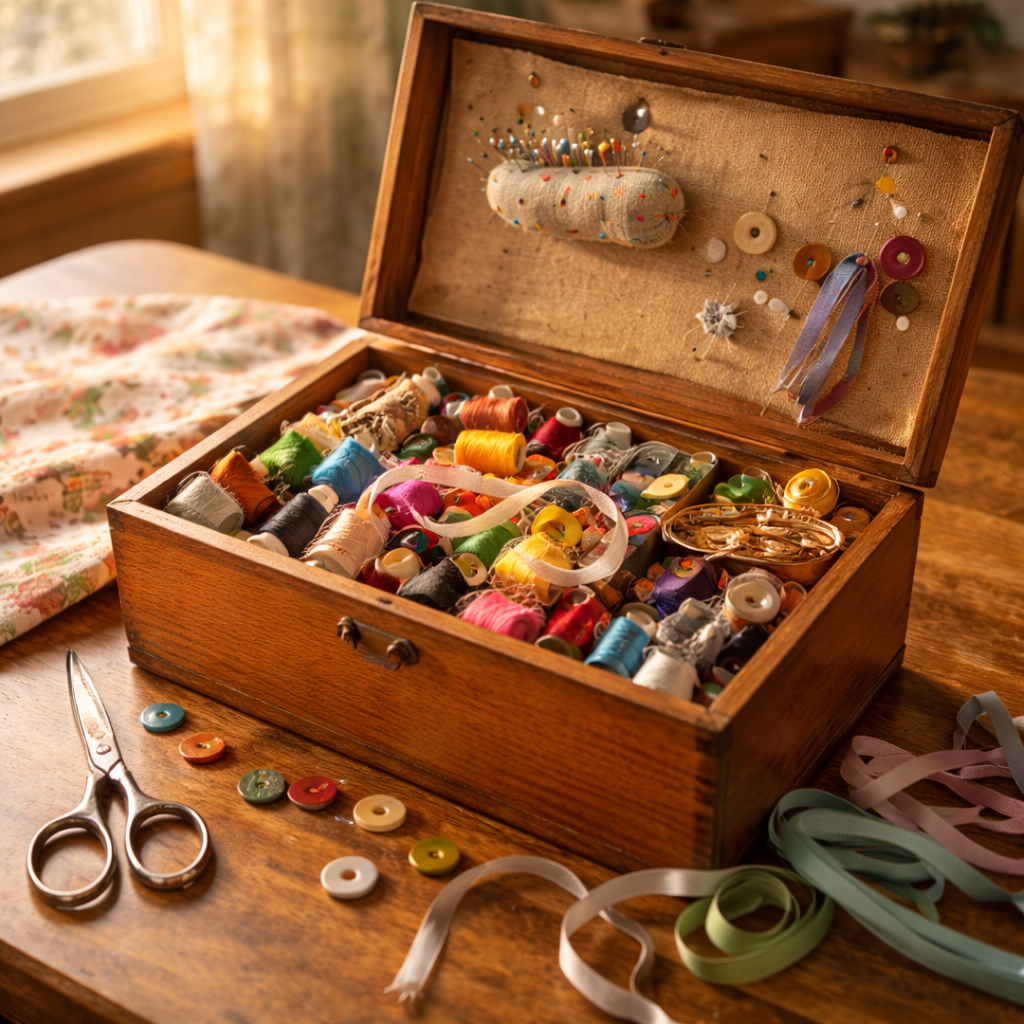
And on the shelf, right above the table, there was the box.
It wasn’t a fancy box.
It was wooden, slightly scratched, and the hinge creaked when you opened it. It had a soft, warm smell—wood and time and a hint of old perfume.
Inside was the strangest collection anyone had ever seen.
Short pieces of string.
Ribbons cut too small to tie anything.
Little lengths of yarn.
Bits of twine that looked like they’d been snipped from packages years ago.
Thread that was too short to be threaded through a needle, at least according to anyone who wasn’t Grandma Helen.
It was a box full of “not enough.”
Helen called it her “just in case” box.
Someone once asked her, “Why do you keep all that?”
Helen didn’t even look up from what she was sewing. “Because,” she said, “you never know what you’ll need.”
The grandchildren didn’t understand at first.
They thought the box was silly. They thought it was the kind of thing grown-ups should throw away when they were “being organized.”
But Helen never threw it away.
And slowly, the box began to prove itself.
A button popped off a shirt right before church. Helen opened the box, found a piece of thread the exact right color, and sewed the button back on like it had never left.
A gift needed tying, and the ribbon in the drawer was too wide. Helen opened the box and pulled out a thin ribbon, pale blue, already curled at the ends. She tied the neatest bow anyone had ever seen.
A child’s school project needed a string to hang it from the ceiling. Helen opened the box and found twine, sturdy and perfect.
And then there were the small things.
The things that didn’t really need fixing, but felt better when they were.
A loose tag on a stuffed animal.
A bracelet made from three colors of yarn.
A paper kite that needed a tail.
Each time, Helen opened the box and pulled out exactly what was needed, as if the box had been waiting for that moment.
“You see?” she’d say gently. “Not everything has to be big to be useful.”
The grandchildren began to love the box.
Not because it was magical.
But because Grandma Helen made it feel magical.
She made “not enough” become enough.
She made scraps become solutions.
She made small things matter.
When Helen grew older, she spent more time in that sewing room.
Sometimes she sewed. Sometimes she just sat and sorted the little strings, fingers moving slowly through them as if they were memories.
One afternoon, her grandchild—older now, tall enough to reach the shelf—watched her.
“Grandma,” the grandchild asked softly, “why do you like this box so much?”
Helen smiled without looking up.
“Because it reminds me,” she said, “that you don’t have to have everything. You just have to have something. And you have to be willing to use it.”
The grandchild didn’t fully understand.
But the words tucked themselves away like a piece of ribbon saved for later.
Years passed.
Helen passed too, the way people do—leaving behind a house full of quiet and a family full of careful voices.
After the funeral, the family began sorting.
They did it respectfully. Gently.
They opened drawers and found fabric. They found patterns folded and refolded. They found old needles in a tin that had once held peppermints.
Someone reached for the box of strings.
“Well,” they said, “this can probably go.”
And then the youngest grandchild—very small, with sleepy eyes—walked into the room, saw the box, and hugged it tight to their chest.
“I want that,” the child said, voice firm in the simple way children are firm.
The adults paused.
“It’s just little strings,” someone said gently.
The child shook their head. “It’s Grandma’s,” they whispered.
So the box stayed.
Years later, that child was grown.
Not fully grown, not in the way people mean when they say “grown,” but grown enough to live in their own home. Grown enough to have days that felt hard and too fast and a little lonely.
One evening, a button came loose on a coat.
They searched for thread, but everything was the wrong color.
Then they remembered the box.
They opened it.
The hinge creaked, just like it always had.
Inside were the bits of ribbon and string and thread—still small, still imperfect, still “not enough” to anyone who didn’t know better.
And there, tucked among the pieces, was the perfect thread.
Not much.
But enough.
The person laughed quietly, feeling something warm rise in their chest.
As they sewed the button back on, they heard Grandma Helen’s voice in their memory, calm and certain:
“You never know what you’ll need.”
And somehow, in that moment, it wasn’t just about the button.
It was about all the little things people save.
All the small kindnesses.
All the tiny hopes.
All the ways you make “not enough” become enough, one careful stitch at a time.