Grandma Ruth always made more cookies than anyone truly needed.
If you asked her why, she would say something practical, like, “Well, flour comes in a bag and butter comes in a stick, and you can’t just leave a recipe half-finished.” She’d say it like the cookies were an unavoidable consequence of mathematics.
But everyone in the family knew the real reason.
Grandma Ruth liked the moment when the cookie plate got quiet.
It happened every single time.
The oven would warm the whole house until it smelled like brown sugar and vanilla. The windows would fog slightly, even if it wasn’t cold outside. And the grandchildren—no matter how tired or cranky they’d been before—would drift toward the kitchen like sleepy little moths, pulled by something sweet and familiar.
Ruth’s kitchen was the kind of kitchen that never felt hurried.
The table was sturdy and scratched in a hundred places, as if it had held every craft project and every homework page and every glass of milk that ever mattered. The chairs didn’t match, but they didn’t need to. The cookie tin on the counter had a dent in the lid, and the wooden spoon in the crock looked older than time.
Ruth would set the plate of cookies down right in the center of the table, as if she were placing a small treasure where everyone could see it.
And then she’d wash her hands and dry them on the same towel she always used.
She did that part slowly. Like she was giving the cookies time to settle into being cookies.
The children would each take one. Then another. Then they’d start asking for “just one more,” even while crumbs clung to their cheeks.
Sometimes they talked the whole time—about school, about a silly joke, about a game they wanted to play later.
Sometimes, on quieter days, they ate with the peaceful seriousness of children who are almost too tired to be excited.
Either way, the plate would change.
It would go from full to half full, from half full to mostly empty.
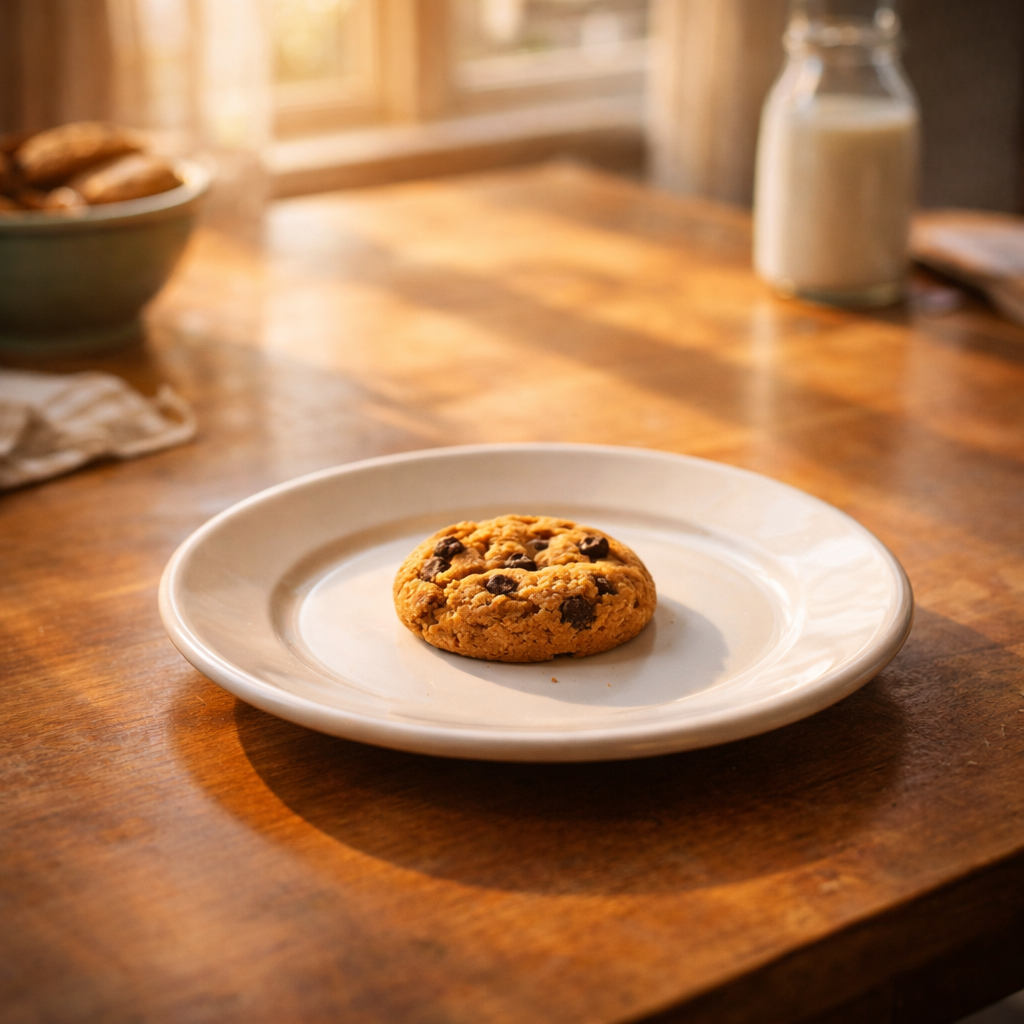
And then—always, always—there would be one cookie left.
Just one.
It sat there on the plate like it had all the time in the world.
That was when Grandma Ruth would glance over, as if she had only just noticed it.
“Well,” she’d say, in the exact same calm voice every time. “Looks like we’ve reached the hard part.”
The children knew what she meant.
The last cookie had rules.
Not written rules, not shouted rules, but rules all the same.
The last cookie wasn’t for the fastest hands.
It wasn’t for the one who asked first.
It wasn’t even for the one who wanted it most.
The last cookie was for something else.
Ruth would carry her dish towel over to the table and fold it twice, very neatly, as if folding the towel helped her fold her thoughts too. Then she’d sit down and nod toward the plate.
“This cookie,” she’d say softly, “has a job.”
The children would lean in, even though they’d heard it before.
Because bedtime stories are like that. You don’t hear them because you don’t know what happens. You hear them because you love what happens.
Ruth would continue.
“It’s not for the hungriest,” she’d say. “Or the loudest. Or the one with the best argument.”
The children would sit a little straighter.
“It’s for the one who can wait.”
The room would change then.
Not dramatically, not like a storm rolling in. Just gently, like the air settling.
The clock ticked.
The last cookie cooled.
Somebody would swallow a little too loudly.
Somebody would look at the cookie, then look away quickly, as if staring at it would be rude.
Somebody would whisper, “I don’t even want it,” in a voice that sounded suspiciously like wanting it.
And Ruth would just watch, her eyes kind, her expression quiet.
She wasn’t trying to trick anyone. She wasn’t trying to make anyone feel bad.
She was teaching something that cookies were perfect for teaching.
How to pause.
How to think.
How to notice what you really wanted—and what mattered more than that.
One afternoon, the oldest grandchild, who liked to win at everything, reached for the cookie.
His fingers hovered over it.
Then he hesitated.
Ruth said nothing.
The child pulled his hand back and cleared his throat, pretending he hadn’t been about to grab it.
Another time, a different grandchild announced, “I’m fine. I’m full,” and then watched the plate like it was a ticking bomb.
Ruth said nothing.
Sometimes the last cookie was taken quickly, and that was that.
Ruth never scolded.
She would simply nod, as if she were saying, That’s one way to do it.
But the most important afternoons were the ones when no one took it right away.
On those days, the cookie sat there longer and longer.
Sunlight shifted across the wooden table. The warm patch of light moved like a slow animal, crawling toward the plate.
And the children started to feel the tug-of-war inside themselves.
I want it, their eyes said.
But I don’t want to be the kind of person who grabs it.
But it’s only a cookie.
But it’s the last one.
Ruth watched it all with the patience of someone who had lived long enough to know that tiny lessons are often the ones that last.
Then, on one particular afternoon, the youngest grandchild—small, quiet, the kind of child who often listened more than she spoke—slid off her chair and walked over to the plate.
Everyone held their breath.
She didn’t snatch the cookie.
She didn’t declare victory.
She simply picked it up carefully and broke it cleanly in half.
The snap was soft, but it sounded loud in the quiet kitchen.
Then she looked around the table.
“We can share,” she said, as if this were the most ordinary thing in the world.
For a moment, no one spoke.
Because something in the room had shifted again—this time in a warm way.
Ruth’s eyes softened.
She didn’t smile like a person who’d won a game.
She smiled like a person who’d watched something good arrive right on time.
Ruth reached for two napkins, folded them, and placed each half on its own napkin.
She handed one half to the youngest grandchild. Then she broke the other half into smaller pieces and passed those around, one by one.
No one complained that their piece was smaller.
No one argued that it wasn’t fair.
Because it felt fair in the way that matters most.
The cookie, shared, tasted better.
It always did.
Years passed after that.
The grandchildren grew. They became teenagers who raided the fridge and pretended they didn’t need anybody. They became adults who rushed through errands and forgot to slow down.
But every once in a while, in a different kitchen, at a different table, they found themselves staring at the last cookie on the plate.
And they paused.
They remembered the warm kitchen. The slow ticking clock. The way Grandma Ruth’s voice sounded like she had all the time in the world.
They remembered that wanting something isn’t wrong.
But choosing something kinder can feel even better.
And sometimes—just sometimes—they broke the last cookie in half.